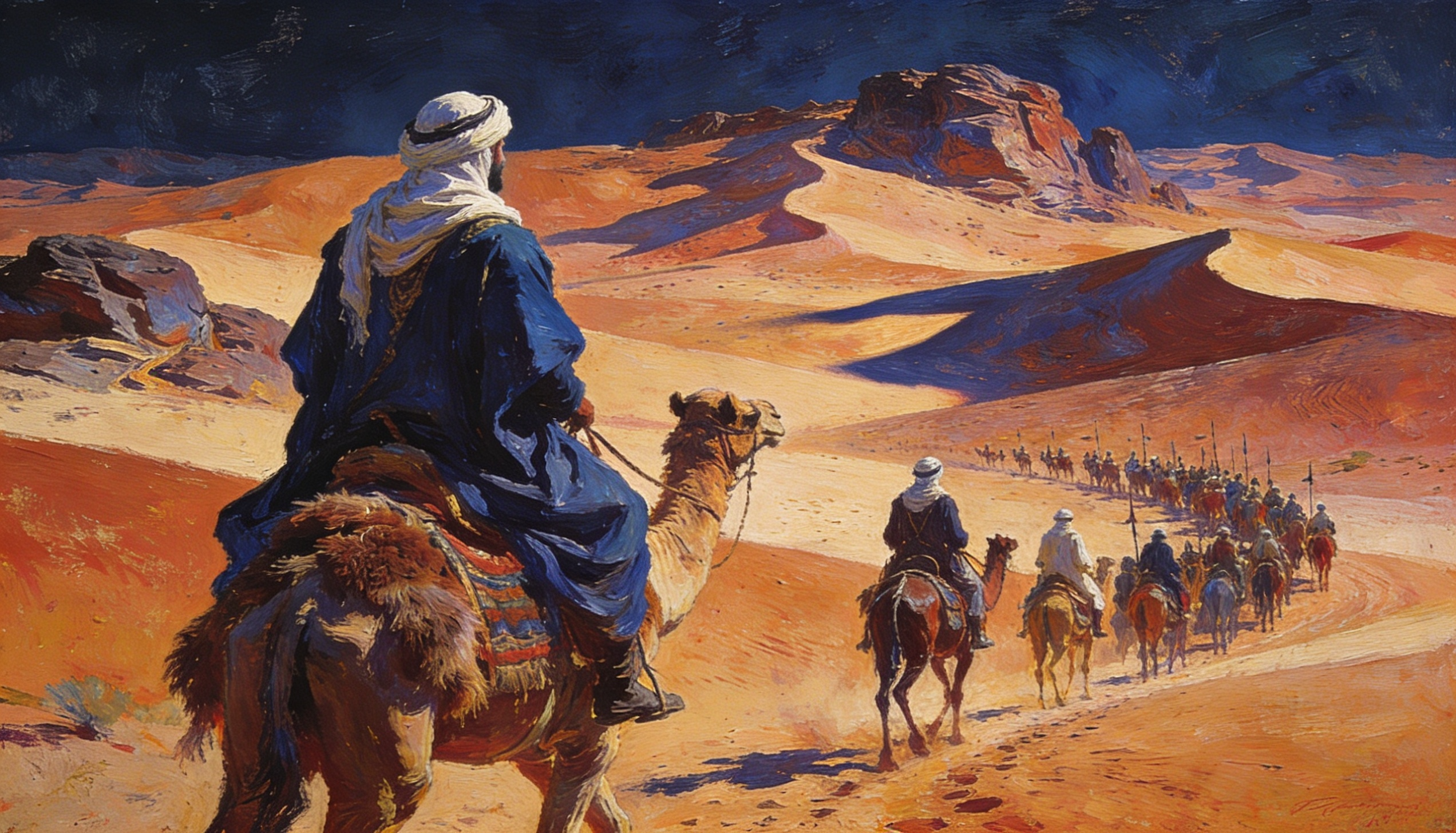
Prophet Muhammad (s.a.w) is known to many people as a religious leader, but have you considered that he was also a political strategy genius?
Prophet Muhammad was a success in both the “secular and the religious” realm. The earthly and the heavenly. The dunya and the akhirah.
Unfortunately, most Muslims do not see this. Most Muslims only see the Prophet (saw) as a teacher on how to do specific rites. This is a downgraded view of the Prophet (saw).
The truth is the Prophet (saw) was unbelievably successful in all realms. He changed and brought a significant impact to the world. Cited as the most influential man in history by Western scholar Michael H. Hart, the Prophet (saw) brought great changes to humanity.
That is why we MUST learn the sirah (bigraphy of the Prophet (saw)). What we are longing desperately for is in the sirah, including the recipe for justice and peace.
لَّقَدْ كَانَ لَكُمْ فِى رَسُولِ ٱللَّهِ أُسْوَةٌ حَسَنَةٌۭ لِّمَن كَانَ يَرْجُوا۟ ٱللَّهَ وَٱلْيَوْمَ ٱلْـَٔاخِرَ وَذَكَرَ ٱللَّهَ كَثِيرًۭا
There has certainly been for you in the Messenger of Allāh an excellent pattern for anyone whose hope is in Allāh and the Last Day and [who] remembers Allāh often.
Quran, Al-Ahzab, 33:21
Throughout the lifetime of the Prophet Muhammad, s.a.w., there have been numerous strategic decisions made by the Prophet.
The Prophet in Makkah vs Madinah
Before we go deeper into studying the 4 most strategic moves made by the Prophet Muhammad, s.a.w., we have to understand that the sirah of the Prophet is mainly divided into two:
1. Makkiyyah Phase
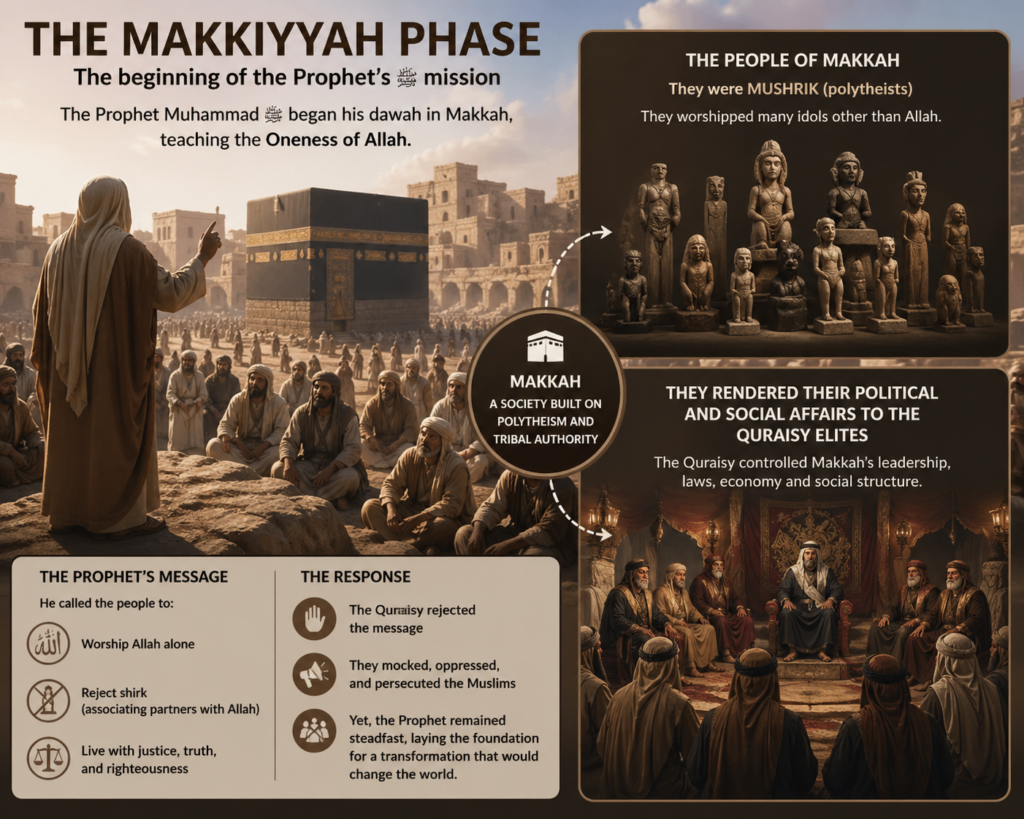
The Makkiyyah phase is the phase where the Prophet just began dakwah and teaching about the oneness of God. The people of Makkah were mushrik (polytheists) and they not only worshipped other than God but they also rendered their political and social affairs to the Quraisy elites of the time.
When the Prophet began dakwah, he was faced with negative backlash from the Quraisy elites. The Prophet was a nobleman, but he did not hold political or economic power over the Makkah political and social environment.
Why was there backlash? Why are they so against the teaching that God is only one, not many? Here’s where most people failed to ask the question…
The Quraysh elites of Makkah received thousands of pilgrims every year to the Ka’bah in Makkah. And what does pilgrims mean? It means.. MONEY. Pilgrims from all around the world who have travelled all the way need to pay the Quraisy money in order to be able to do the hajj.
By receiving thousands of pilgrims a year to Makkah, the Quraiys elites would do everything to protect their “rice bowl” (or… should I say… dates bowl??).
Islam is not just a “religion.” It was a way of life. Accepting the oneness of God means accepting that everything is rendered to God. Law, justice, social life, politics, kingdomship, all belong to God.
The Quraisy found this to be a threat that would undermine the legitimacy of their rule. And so, the harassment and persecution begin.
2. Madaniyyah Phase
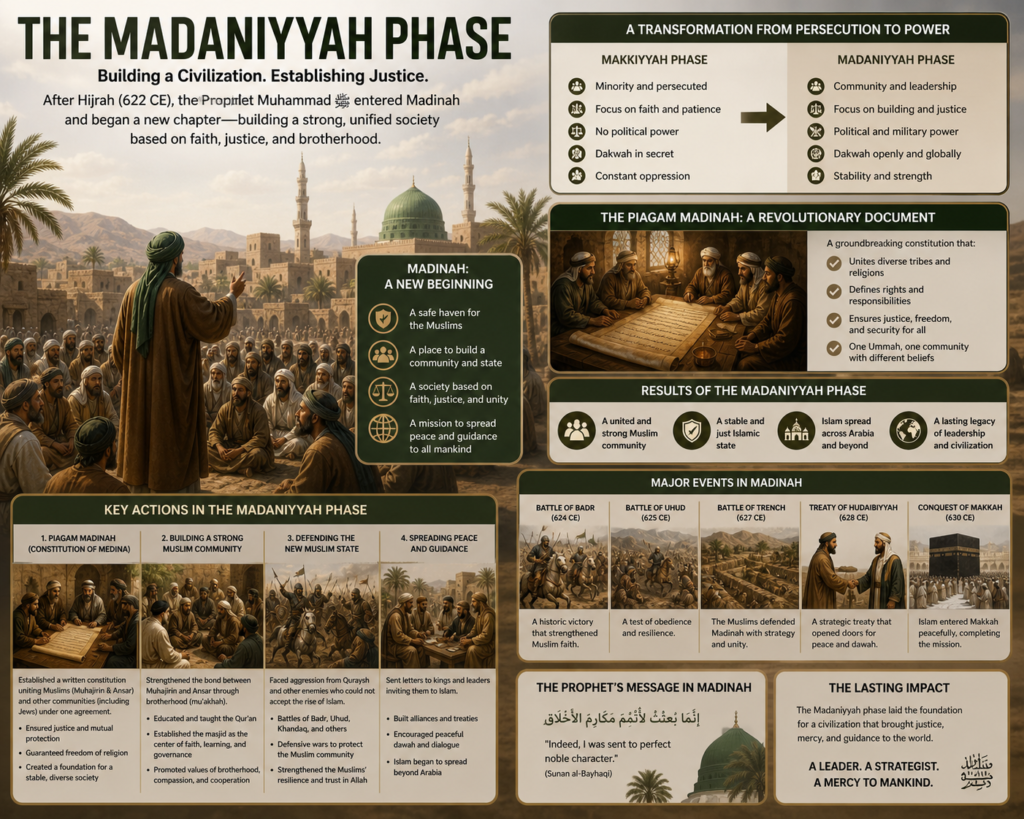
The Madaniyyah phase is the phase after the hijrah (migration) of the Prophet (saw) and his companions from Makkah to Madinah. In Madinah, the Prophet (saw) is the rightful political leader of the inhabitants of the city of Madinah.
This marks a significant shift in the state of the Muslims, from being the ones who are oppressed to having dominion and authority.
Now that the two most important phases of the Prophet’s mission are explained, let’s dive right into the four most strategic moves made by the Prophet (saw) in his mission to establish Islam as a way of life (din).
1. Dar Al-Arqam
Dar Al-Arqam means the “house of al-Arqam” referring to the house where the Prophet and the companions used to congregate without the people outside knowing.
The purpose is to teach and train the companions the message of Islam – the oneness of God in all aspects of life, from personal faith to community.
Think of this as the (discreet) learning centre of Islam in the beginning. It was selected as a place to meet, discuss, and learn about Islam, safe from any threats of the Quraisy elites and outsiders.
Why is this a strategic move?
This is where the foundation is built. Where iman (faith) is not only built, but strengthened. It is through this strength of faith that the Muslims were able to make the hijrah, fight off threats from the Quraisy, and continue to persevere.
The spirit of this strategy can be found in Surah al-Muddathir:
يَـٰٓأَيُّهَا ٱلْمُدَّثِّرُ ١ قُمْ فَأَنذِرْ ٢ وَرَبَّكَ فَكَبِّرْ ٣ وَثِيَابَكَ فَطَهِّرْ ٤ وَٱلرُّجْزَ فَٱهْجُرْ ٥
O you who covers himself [with a garment]. Arise and warn. And your Lord, glorify. And your clothing, purify. And uncleanliness, avoid.
Quran, Al-Muddathir, 74:1-5
2. The Hijrah
Hijrah means “migration,” referring to the migration of the Prophet (saw) and his companions from Makkah to Madinah in the year 622. It was the command of Allah for the Prophet to make the migration.
Why is this one of the most strategic moves?
During the Makkiyyah phase, the Muslims have no sovereign control. They were unable to spread the oneness of God because the Quraisy were threatened by it. So the Quraisy, with nails of steel, persecuted and harassed the followers of the Prophet Muhammad.
Migration to Madinah was not “fleeing” away. Before the hijrah took place, all the heads of tribes of Yathrib (which will later be named Madinah) made a pledge with the Prophet (saw) called the ” Second Pledge of Aqabah.”
In the Second Pledge of Aqabah, the heads of tribes accepted the Prophet (saw) as their rightful political leader. The hijrah was, significantly, moving from a place where the Muslims had no political control (Makkah) to a place where they have control (Madinah).
The Prophet (saw) and the companions could have just stayed in their homeland (Makkah) and slowly continued spreading Islam. But they didn’t. Why?
In fact, the Prophet (saw) was offered political authority by the Quraisy in exchange to stop talking about the oneness of God. But the Prophet (saw) refused.
Why didn’t the Prophet (saw) and the companions simply continue to slowly da’wah in Makkah discreetly?
Most would say it was because of the persecution and harassment. But if that were the case, the Muslims could’ve just migrated to modern-day Ethiopia under the reign of King Najashi.
But they didn’t stay there for long. Why?
It was because the hijrah was not just a “migration.” It was a departure. Departure from the shirk (polytheistic) system of the Quraisy and into the tauhid system of Islam. From no political control to having political control. From a man-made legal system to a divinely ordained system.
I usually use this analogy in coding (sorry to the non-coders out there, you won’t be able to understand this, too bad): Let’s say you want to develop a software. You write the code. Then you test it. If there’s an error when you test it, you have to look back at the code you wrote and find where you wrote it incorrectly.
Now if the code is only three lines deep, it’s easy for you to know where the mistake is. But what if the code is 3,000 lines deep? Maybe you’ll be able to identify it if you’re the one who wrote it. But what if your colleague wrote it and passed everything to you without any explanation? You will have to temporarily erase 90% of the code, and gradually build it back up to the point where the error occurred.
Now… what if a virus attacked the code and changed 546 letters in the code out of the 3,000 lines? You might as well just start from scratch. There’s no use trying to fix something that’s so complicated.
The same is with the hijrah. A fresh start. System reset. The right foundation – the foundation of Tauhid. No use trying to fix the “virus-infected” Quraisy-led Makkah.
وَٱلَّذِينَ ءَامَنُوا۟ وَهَاجَرُوا۟ وَجَـٰهَدُوا۟ فِى سَبِيلِ ٱللَّهِ وَٱلَّذِينَ ءَاوَوا۟ وَّنَصَرُوٓا۟ أُو۟لَـٰٓئِكَ هُمُ ٱلْمُؤْمِنُونَ حَقًّۭا ۚ لَّهُم مَّغْفِرَةٌۭ وَرِزْقٌۭ كَرِيمٌۭ
And those who have believed (iman) and migrated (hijrah) and fought (jihad) in the cause of Allāh and those who gave shelter and aided – it is they who are the believers, truly. For them is forgiveness and noble provision.
Quran, Al-Anfaal, 8:74
3. The Constitution of Madinah
The constitution of Madinah is a contract between the Prophet (saw) and the different groups in Madinah into a single political community, covering the Muslim migrants (Muhaajirin), the local Muslim tribes (Aws & Khazraj, a.k.a the Ansar (lit. “helpers”)), the Jewish tribes in Madinah, and the allied tribes outside of Madinah.
Why is this one of the most strategic moves?
It was essentially a proclamation of the political authority of the Prophet (saw) at that time. In exchange for bringing peace among the warring tribes of then-Yathrib, they now unite under the leadership of the Prophet (saw).
The Constitution of Medina was not merely a peace agreement, but a calculated restructuring of power within Yathrib. By positioning the Prophet Muhammad as the final arbiter in disputes, it shifted authority away from fragmented tribal leadership toward a centralised but accepted leadership.
This move was strategic because it did not abolish tribal structures outright. Instead, it preserved internal autonomy while binding all groups to a higher political order. In doing so, it avoided resistance that would typically arise from forced centralisation, allowing unity to emerge organically through mutual interest rather than coercion.
At the same time, the inclusion of Jewish tribes and allied groups under the same framework created a broader coalition that strengthened the city’s defensive and economic position. Rather than operating as isolated tribes, the signatories became part of a coordinated system of mutual protection, reducing internal conflict and deterring external threats.
Furthermore, the Constitution introduced a new basis of political identity, the concept of the ummah, which transcended lineage and tribal affiliation. This was a significant shift from pre-Islamic norms, where loyalty was primarily tied to kinship. By redefining belonging in political and moral terms, the Prophet established a more cohesive and scalable model of governance.
In this sense, the Constitution of Medina functioned as both a stabilising mechanism and a foundation for expansion. It created internal order while remaining flexible enough to incorporate new allies, allowing the political community to grow without undermining its core structure.
4. The Treaty of Hudaibiyyah
In 628, the Prophet (saw) received a revelation through a dream to perform umrah. So they set out to Makkah without any intention to fight. However, they were stopped at Hudaibiyyah. The Quraisy of Makkah were fearful that the Prophet (saw) wanted to invade Makkah.
At this point, negotiations began between the Muslims and the Quraysh, resulting in the Treaty of Hudaybiyyah. Although the terms initially appeared unfavourable to the Muslims, the Prophet Muhammad accepted them, prioritising long-term stability over immediate advantage.
The treaty included several key conditions. First, both parties agreed to a ten-year truce, effectively halting hostilities. Second, the Muslims would return to Medina without performing umrah that year, but would be allowed to return the following year to complete it peacefully. Third, any Meccan who migrated to Medina without permission would be returned, while Muslims who defected to the Quraysh would not be returned.
The treaty faced dissatisfaction among the companions of the Prophet (saw). However, the Prophet (saw) decided to proceed with the treaty after considering all aspects.
Why is this one of the most strategic moves?
When the truce was signed, it allowed a period of peace. This means the message of Islam could be spread without any threat from the Quraysh of Makkah. Tribes can now pledge allegiance to the Prophet (saw) without risk of persecution from the Quraysh of Makkah.
Here is where it gets interesting… Islam spread far and wide so fast. So fast that the army of the Muslims grew from around 1,400 people to 10,000 (approx) in just two years.
When the Quraysh of Makkah broke the terms of the treaty, the Muslims retaliated by sending an army of 10,000 people to Makkah. Makkah, the holy shrine built by patriarch Ibrahim (as), was surrendered to the Muslims without any bloodshed.
Conclusion
Ultimately, all four events above are very important in the Sirah of the Prophet (saw). The first one contributed to the second one and the second to the third, and so forth. However, by having a deep understanding of all four main events below and their significance will allow one to appreciate the mission of the Prophet (and in turn, our mission too) more greatly.


Be First to Comment